
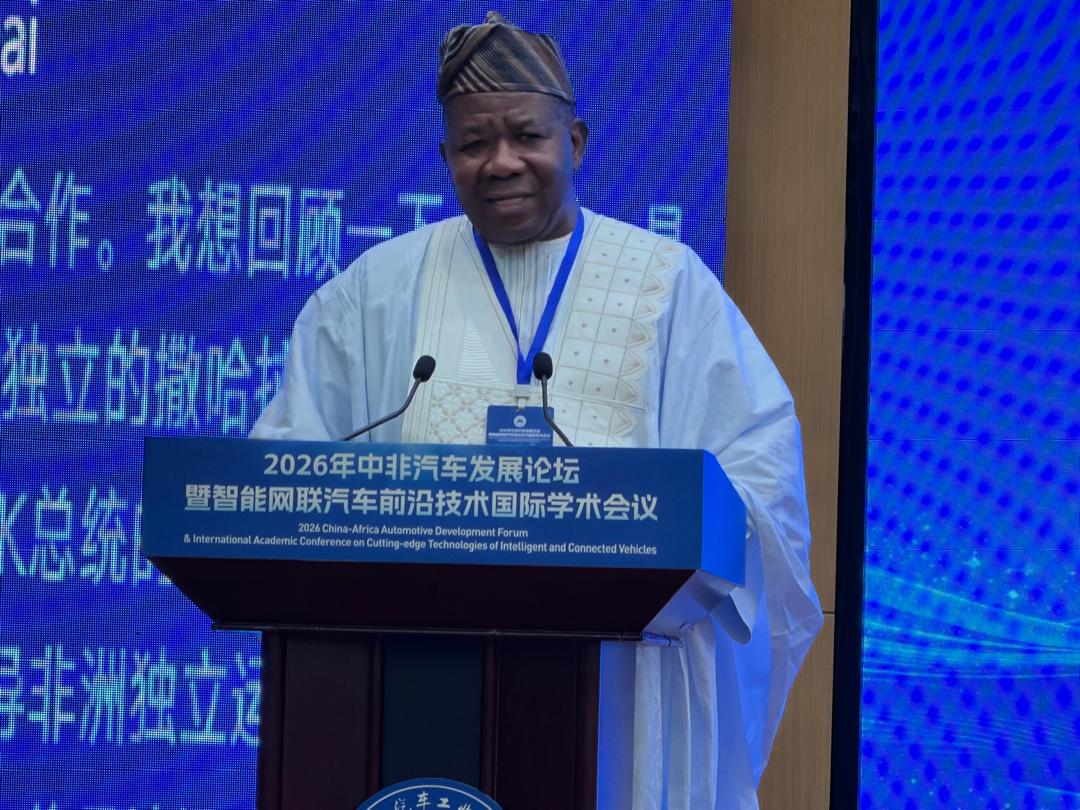
African countries should move beyond importing vehicles and work with China to develop technology, build local manufacturing capacity and train engineers, KNUST Vice-Chancellor Prof. Christian Agyare said at the third China-Africa Automotive Development Forum.
In an address delivered on his behalf by Prof. Edmund Ekuadzi, Dean of KNUST’s International Programmes Office, Prof. Agyare called for partnerships that support technology transfer and joint development as Africa pursues cleaner transport.
The forum, held at the Hubei University of Automotive Technology (HUAT) in Shiyan, was jointly organised by HUAT and the Confucius Institute at KNUST.
Its theme was “Contemporary China/Africa Partnership – Promoting Technical Cooperation and Industrial Synergy in New Energy Vehicles and Intelligent Manufacturing.”
Prof. Agyare, who also chairs the board of the Confucius Institute at KNUST, identified growing transport demand, complementary resources and skills development as three reasons for stronger cooperation.
“First, Africa is urbanizing and motorizing at unprecedented speed. Ghana, Kenya, Nigeria, South Africa and others urgently need affordable, clean, and durable mobility solutions. The era of second-hand, high-emission vehicles, common in Africa, must give way to a new era of green mobility made for Africa, and where possible, made in Africa.
“Second, China leads the world in new energy vehicle technology, battery supply chains, and intelligent manufacturing. Africa possesses a youthful population, abundant renewable energy potential, and critical mineral resources and makes this a natural complementarity. Our task should be to move from trade to technology transfer, from importation to local assembly and manufacturing, from consumption to co-creation.
“Third, even though talent is the bottleneck, it is also the opportunity. We cannot build an automotive industry without automotive engineers, technicians, and innovators. This is where our universities and the Confucius Institute model of ‘Chinese + Vocational Skills’ becomes strategic.”
Prof. Agyare, who was speaking barely two months after his investiture as KNUST’s 13th Vice-Chancellor, said the university would use its College of Engineering and Confucius Institute to train Ghanaian and other African engineers in Chinese language and automotive technologies.
The training would cover electric vehicle design, lightweight materials, battery management and intelligent systems, he said.
He proposed four priorities: joint research and innovation, local production, technical training and policy dialogue.
On research, he called for joint laboratories and jointly developed patents covering lightweight electric vehicle structures, battery thermal management for tropical climates and intelligent connected systems suited to African roads.
He also urged partnerships between Chinese vehicle manufacturers and African assemblers, industrial parks and start-ups. Citing Hubei Sanhuan Automobile Co. Ltd. as an example, he proposed exploring vehicle assembly opportunities in Kumasi and other African cities.
On training, Prof. Agyare called for formal dual-degree programmes, short courses for technicians and faculty exchanges between HUAT and KNUST, with certification through the Confucius Institute.
He urged governments to support investment through electric vehicle import incentives, charging infrastructure standards and local content requirements.
“Contemporary automobile is no longer just a machine – it is a platform for clean energy, digital intelligence, and shared prosperity. From Shiyan in 2024, to Kumasi in 2025, to Shiyan again in 2026, we have built trust. Now we must build factories, curricula, and futures together,” he said.
Prof. Agyare said the Confucius Institute would continue to support cooperation in language, technology and cultural exchange.
KNUST’s Head of the Department of Mechanical Engineering, Prof. Yesuenyeagbe Atsu Kwabla Fiagbe, also called for partnerships with automotive companies to establish a competency-based technician training facility at the university for servicing modern Chinese vehicles.
He spoke on “Automotive Servicing and Innovation with Competency-Based Training for Modern Technology Chinese Vehicles.”
UNESCO’s representative in Ghana, Mr. Edmond Moukala, highlighted the organisation’s blueprint for sustainable and responsible mining. He urged partners to ensure that cooperation between China and Africa, including the KNUST-HUAT partnership, delivered responsible development and wider public benefits.


